How Can a Car Fly? The Mechanics Behind Tesla’s Thruster Roadster
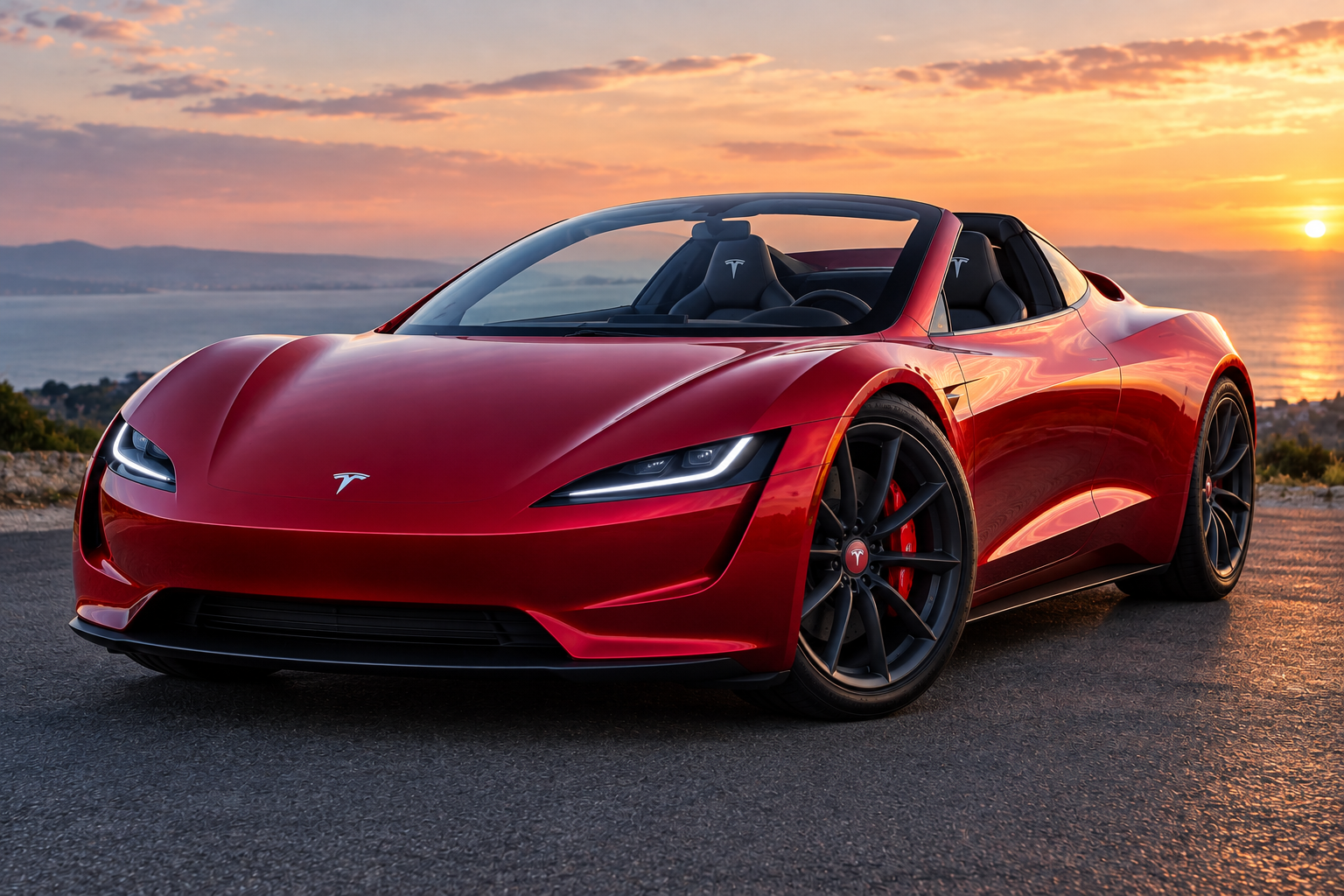
Tesla’s new Roadster does not fly like a plane or a drone: it hops on powerful gas thrusters borrowed from SpaceX, rolls in midair, and lands on its wheels.
A rocket, not a wing
A plane flies on lift from its wings, and a drone on spinning rotors. The Roadster uses neither: it uses thrusters, which work on Newton’s third law. Push mass out one way and the car is pushed the other.
At Tesla’s launch event at a SpaceX test site in Texas, the car launched off a ramp and did a barrel roll over a line of parked cars. The system has main thrusters at the rear plus smaller attitude-control thrusters that steer the car’s orientation.
What is a cold-gas thruster?
Most rockets burn fuel to make hot, fast exhaust. A cold-gas thruster skips combustion entirely, in three steps:
- Store: gas is held in a strong tank at very high pressure.
- Release: a valve opens and the gas escapes through a shaped nozzle.
- Accelerate: the nozzle speeds the gas up as it expands, and the escaping gas pushes the car the other way.
The trade-off is that cold gas gives much less push per kilogram of propellant than burning fuel. But it is simple, instant and easy to control, which is why spacecraft have long used it for fine steering. Reports say these are cold-gas thrusters developed by SpaceX for its reusable rocket-landing systems.
Three jobs, three systems
| Part | Job | What Tesla says |
|---|---|---|
| Main thrusters (rear) | The big push for launching and accelerating | 0 to 60 mph in under a second |
| Attitude-control thrusters | Short bursts that rotate the car (roll, pitch, yaw) | Enabled the midair barrel roll and level landing |
| Wheels and suspension | Absorb the touchdown | Car landed on its wheels |
Tesla’s pitch is that every normal car is limited by tire grip, and the thruster system produces 4 to 5 times the force the tires can.
Why it hops instead of cruising
The limit is physics. Staying airborne means producing thrust greater than the car’s weight for as long as you want to stay up. A car is heavy, and a tank of pressurized gas empties fast. So you get a powerful burst, a short arc through the air and a landing, not sustained flight.
Tesla also showed an invite-only, single-seat “Rocket” version with a “full flight system,” but details are thin.
Will you be able to buy one?
Not soon. Tesla said production begins in 2028 and announced no price. Its reservation page listed $50,000 for the “Performance” Roadster and $250,000 for the “Thrust” version. A thruster-flying car on public roads would also need regulator approval, which is hard to imagine.
The Roadster is not a flying car in the Jetsons sense. It is an electric sports car with a rocket-assist system, built on stored high-pressure gas, nozzles and very precise control. Whether it becomes more than a spectacular stunt is the open question.
Real flying cars, or just a great show? Tell me in the comments.
Sources
- Space.com: SpaceX thrusters just made a Tesla Roadster “fly”
- The Irish Times: Tesla unveils “flying” sports car with SpaceX rocket thrusters
- ABC News 4: “Flying cars are real”: Elon Musk and Tesla debut new Roadster
The cold-gas thruster explanation is general engineering background, not taken from these pages.